
How FIFA Turns a Tournament Into a Total Brand Experience
— And what every brand can learn from it
There are sporting events. And then there is the FIFA World Cup.
What separates the two isn’t just the scale — 48 nations, 104 matches, three host countries, billions of viewers. It’s the degree to which the entire commercial universe around the tournament is built and managed as a unified brand experience. Visual merchandising is at the center of that.
From the official online store to stadium retail floors to pop-up shops on the Third Street Promenade in Santa Monica, FIFA 2026 has constructed one of the most sophisticated visual merchandising ecosystems ever deployed around a sporting event.
Here’s how it works — and why it matters far beyond football.
1. The Visual Identity System: One Language, Every Surface
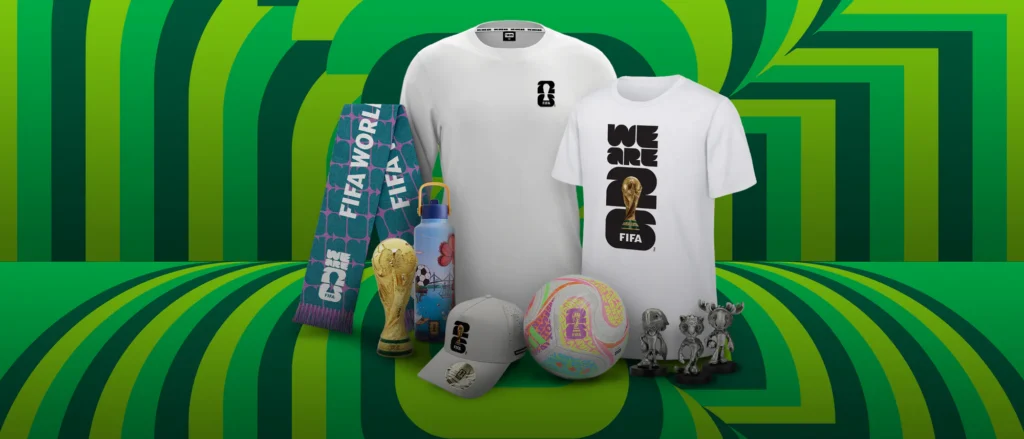
Everything begins with a rigorously controlled brand system. FIFA’s licensed products are built around a unified visual language — the iconic Tournament Device Pattern and official emblem — designed to capture the essence of the world’s most prestigious sporting event.
The design language uses sharp typography, full-bleed color blocks, and a modular grid that flexes across screen sizes. Bold graphic lettering mimics the shape-driven FIFA emblem — typography that doesn’t decorate, it drives the experience. Color is used deliberately: orange, navy, teal, and gold punctuate each section, connecting to each host city’s brand palette while remaining anchored to the global FIFA design system.
Whether a fan is browsing from Tokyo, walking into a stadium store in Dallas, or spotting a display at Hudson Yards in New York — the visual language is instantly recognizable. That’s not accidental. It’s engineered.
2. The Digital Store: Visual Merchandising by Emotion
The FIFA Official Store doesn’t organize products the way a typical retailer would — by price, category, or gender. It organizes them by identity and emotion.
The primary navigation is built around national pride — shop by your team, your nation, your colors. A fan arriving on the Argentina page doesn’t just see a jersey. They see themselves reflected in a curated collection of scarves, pins, keychains, and apparel that says: this is your tribe, and this is your moment.
KEY DIGITAL MERCHANDISING MOVES
- Limited edition drops treated as events, not just product listings
- Boggi Milano luxury collab elevates the store into genuine lifestyle territory
- 16 host city collections with city-specific visual design
- Homepage headline — ‘Match Day is coming. Discover the gear everyone’s after’ — urgency-led retail copywriting that mirrors the tournament’s momentum
- Nation-based browsing organized by pride and loyalty, not category
3. Physical Retail: The Experience Layer
Online is only half the story. The physical retail operation behind FIFA 2026 is one of the largest and most complex in global sports history.
Fanatics was selected by FIFA to serve as the official on-site retail licensee, managing in-venue retail operations for 104 matches across 39 days in Canada, Mexico, and the United States. In addition to in-venue retail, Fanatics built out bespoke retail experiences at official FIFA Fan Festival locations within host cities.
The approach goes well beyond selling jerseys at a concession stand. In Los Angeles alone, official FIFA World Cup 2026 retail pop-up stores opened across the region — in Los Angeles, Santa Monica, Hollywood, Manhattan Beach, and Torrance — featuring apparel, national team jerseys, accessories, mascot merchandise, and exclusive commemorative items.
In New York, the tournament’s first official retail store opened at Hudson Yards — with FIFA President Gianni Infantino attending the ribbon-cutting personally. This isn’t just retail. It’s destination retail — a statement that the World Cup has arrived and taken up permanent residence in the city’s cultural fabric.
4. The Collectibles Display Strategy: Making Products Feel Precious
Visual merchandising at this level understands something fundamental: the way a product is displayed changes how it is perceived.
Strategic merchandising, themed groupings, and varied display heights increase engagement and impulse purchases. Acrylic display cases preserve memorabilia from dust and damage while enhancing visibility and perceived value. Thoughtful display concepts create a stronger shopping experience and help products stand out during the tournament season.
When sentimental merchandise is displayed with intention, it becomes easier for shoppers to browse, connect with products, and make instant buying decisions.
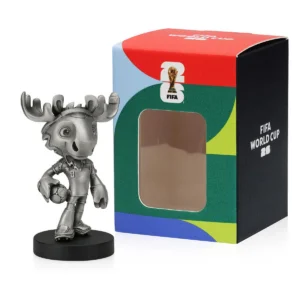
This is why a replica trophy in a glass case sells differently than the same replica trophy in a cardboard box. The object hasn’t changed. The context has.
5. The Brand Extension Universe: Visual Language Beyond FIFA
Perhaps the most revealing aspect of FIFA 2026’s visual merchandising story is how far the brand language has extended beyond official channels.
World Cup merchandising has evolved into a visual language that can be reinterpreted by brands with vastly different identities. Zara launched tournament-inspired pieces referencing Argentina, Brazil, France, Germany, Japan, Mexico, and the USA. H&M unveiled its collection under the slogan ‘We All Play Together.’ Bershka, Pull&Bear, and GAP all entered the conversation.
FIFA’s global licensing program allows authorized partners to use official assets — the FIFA World Cup name, the tournament emblem, mascot, slogans, and host-city branding elements — while national colors, geographic references, flags, and football-inspired design cues can be used without official licensing.
The result is a visual ecosystem where the World Cup’s color palettes, typography, and iconography appear everywhere — from luxury boutiques to fast fashion windows — all reinforcing the same cultural moment and driving each other’s energy.
What This Means for Brands: The Visual Gift Strategy
The FIFA 2026 visual merchandising machine teaches a lesson that applies to every brand — not just sports organizations.
Visual presentation is not decoration. It is the difference between a product and an experience, between a transaction and a memory. Simply placing collectibles in sleek cases is a great start, but creating a truly dynamic display takes more — combining signature items with smaller collectibles to create depth, variety, and a stronger visual story.
For brands building gift programs around the World Cup — or any major occasion — the visual layer matters as much as the product itself. A branded gift set in a beautifully designed box, organized with visual intention, wrapped in the language of the moment, communicates something that no product spec ever could:
We thought about this. We thought about you.
That is what great visual merchandising does. It makes the recipient feel that the gift was inevitable — like it could only have been this thing, presented exactly this way, at exactly this time.
The World Cup window is open. The visual language is already in the air. The question for brands is whether their gifting strategy speaks the same language — or goes unnoticed in the noise.
At Racoob, we design branded gift experiences that are as intentional visually as they are strategically. From product selection to packaging to the moment of opening — every detail is considered.
Because presentation isn’t the finishing touch. It’s the whole point.
Let’s talk →